Running Several Websites Without Losing Track
One site fits in your head. Four do not. Portfolio management is the difference between owning several assets and owning several half-finished projects.
Educational guide · Reviewed September 2026
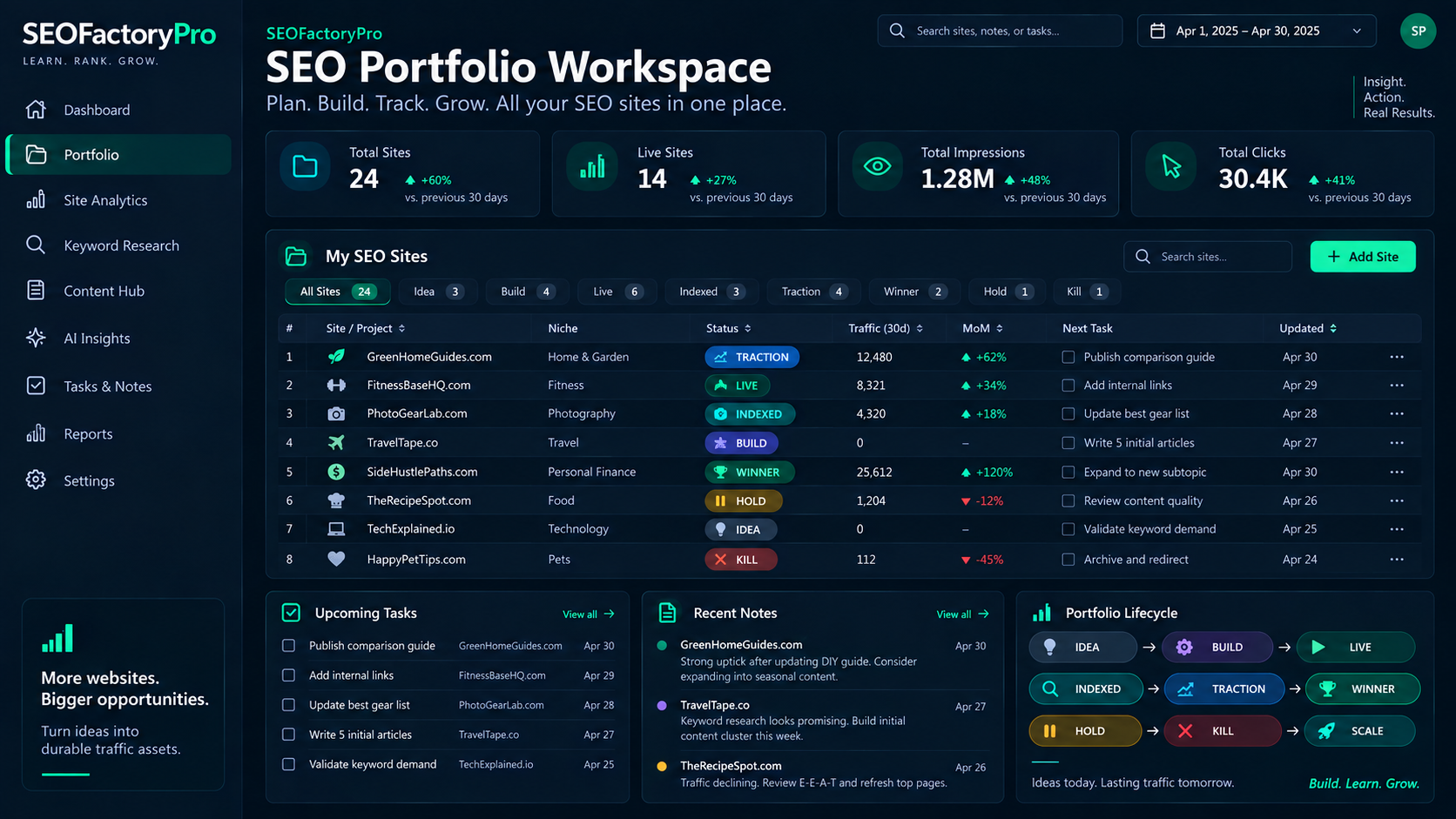
Start with an inventory
One row per website: domain, niche, model, current status, launch date, renewal date, monthly cost, revenue if any, and the single next action. Most portfolio problems are not strategic — they are a forgotten renewal, a site that has had no attention for four months, or two projects quietly competing for the same query.
Give every site a status, not a feeling
Use a small fixed set: researching, building, launched, waiting for data, improving, monetized, paused, retired. A status forces a decision. “Waiting for data” with a review date is legitimate; “I will get back to it” is how projects die.
A review cadence you can sustain
Weekly, look only at the one or two sites in an active phase. Monthly, review the whole portfolio: performance, costs, next actions, and anything worth stopping. Quarterly, ask the harder question — which project deserves more of your time and which should be consolidated or retired.
Track costs honestly
Domains, hosting, tools and any paid content add up quietly across several projects. Record them per site so you can see which assets are actually net positive. A site earning a little while costing more is not a success in progress.
Where AI helps
- Summarising exported performance data into a shortlist of anomalies to inspect.
- Proposing questions: which pages get impressions without clicks, which clusters are silent.
- Turning your review notes into a clear task list per site.
- Drafting the next content brief once you have decided what to build.
In each case the output is a proposal for you to check. A model does not know your niche, your partner relationships or which numbers are incomplete because of reporting delay.
Where AI does not help
It should not decide to expand a project, set prices, or declare a cause for a traffic change. Those need your judgement and your knowledge of what you changed and when. Treat any confident explanation from a model as a hypothesis with no evidence attached.
Decision log
Keep a short log per site: date, what you changed, why, and what you expected to happen. Reading that log against the performance data three months later is the single most useful learning mechanism in this work — far more useful than another tool.