Turning Local Search Intent Into Enquiries
Local service searches are among the clearest commercial signals on the web: someone has a problem now and wants someone nearby to fix it. This guide covers the pages, forms and handover that turn that into a lead worth paying for.
Educational guide · Reviewed September 2026
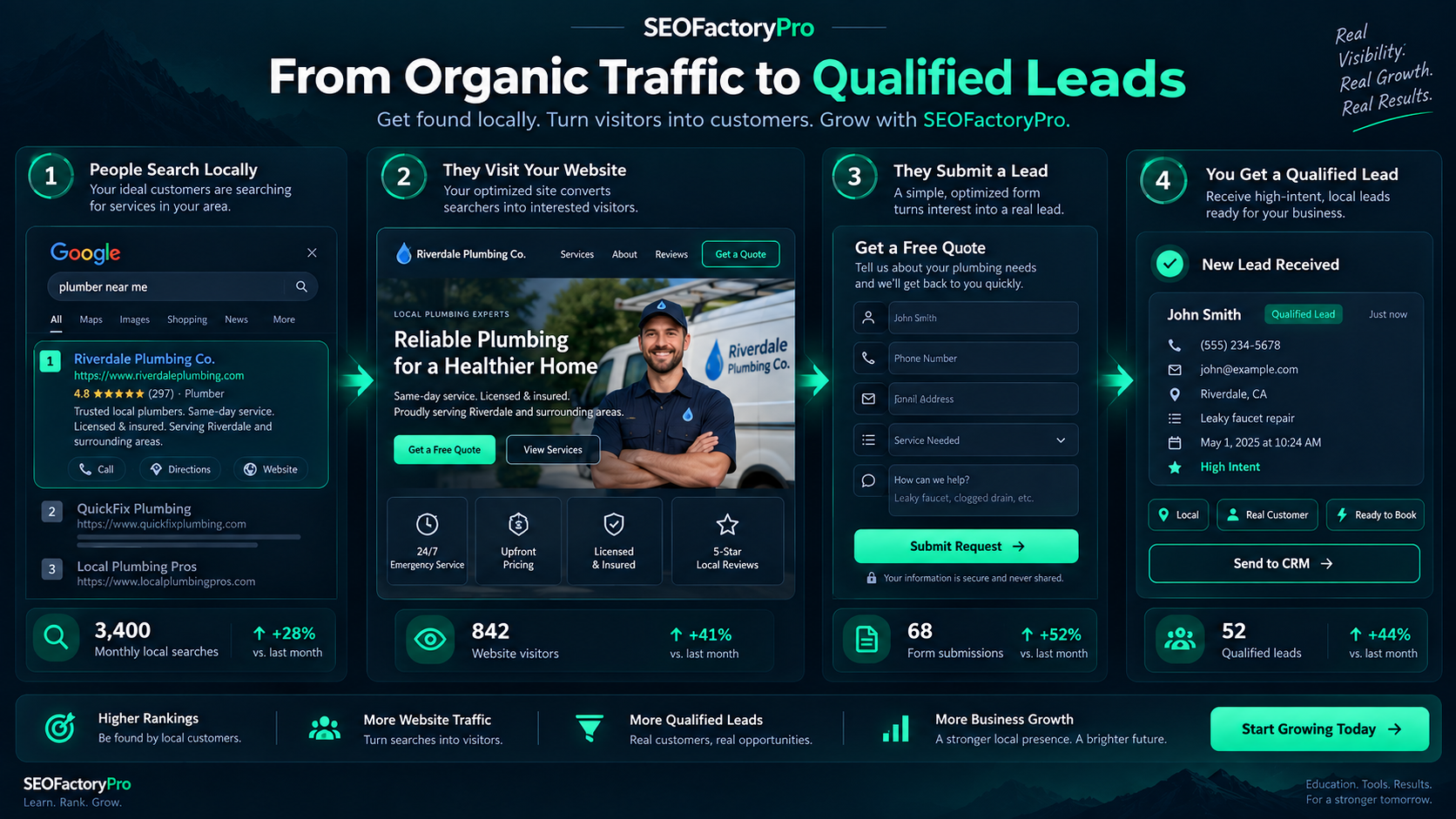
Why local intent converts
A local service query usually carries urgency, a budget and a decision-maker in one search. The distance between “emergency drain unblocking” and a paid job is short. That is why local lead generation is the primary monetization model taught here: you do not have to manufacture demand, only serve it better than the current results do.
The page types that work
- Service hub. What the service is, what it costs, how long it takes, what happens when you book. The page a comparison-stage visitor reads.
- Specific service pages. One page per genuinely distinct job, not fifty thin variants of the same text.
- Area pages. Only where there is something real to say about that area: coverage, travel, local conditions, pricing differences. Mass-produced location pages with a swapped city name are the fastest way to build a site nobody should trust.
- Pricing explainer. The question every visitor has and most competitors dodge.
- Problem guides. Informational pages that catch earlier-stage searches and route them to the service hub.
Designing the enquiry path
Keep the form short and honest: what you need, where, when, and how to reach you. Every extra field costs submissions, so ask only what the partner needs to quote. Label fields properly, keep them keyboard-accessible, show clear error messages, and never claim a submission succeeded unless it did.
Say plainly on the page who the enquiry goes to. If the site connects visitors to an independent local business rather than performing the work itself, write that down. Visitors accept an introduction service; they do not accept discovering they were misled.
Qualification
A lead is useful when the partner can act on it. Capture enough to judge: the job type, rough scope, location, timeframe and a contact method that works. Filter obvious noise — out-of-area requests, jobs the partner does not do, people looking for free advice. A smaller number of qualified enquiries is worth more than a larger number of unusable ones, and it protects the relationship.
Delivery and speed
Deliver instantly and in a form the partner actually reads: an email or message with the full details, plus a record you keep. Track what happened to each enquiry. Without that record you cannot price fairly, defend a disputed lead or prove the arrangement is working.
Handling data responsibly
You are collecting personal details about someone’s home or business. Store only what is needed, pass it only to the partner it was submitted for, say so at the point of collection, and be able to delete it on request. This is both a legal and a reputational requirement.
Common failure modes
Building hundreds of area pages before one proved it could rank. Sending unqualified enquiries and blaming the partner. Promising exclusivity while selling the same lead twice. Adding a phone number nobody answers. Each of these ends the same way: the partner leaves and the asset earns nothing, even though the traffic is still there.