A Method You Can Audit, Not a Growth Hack
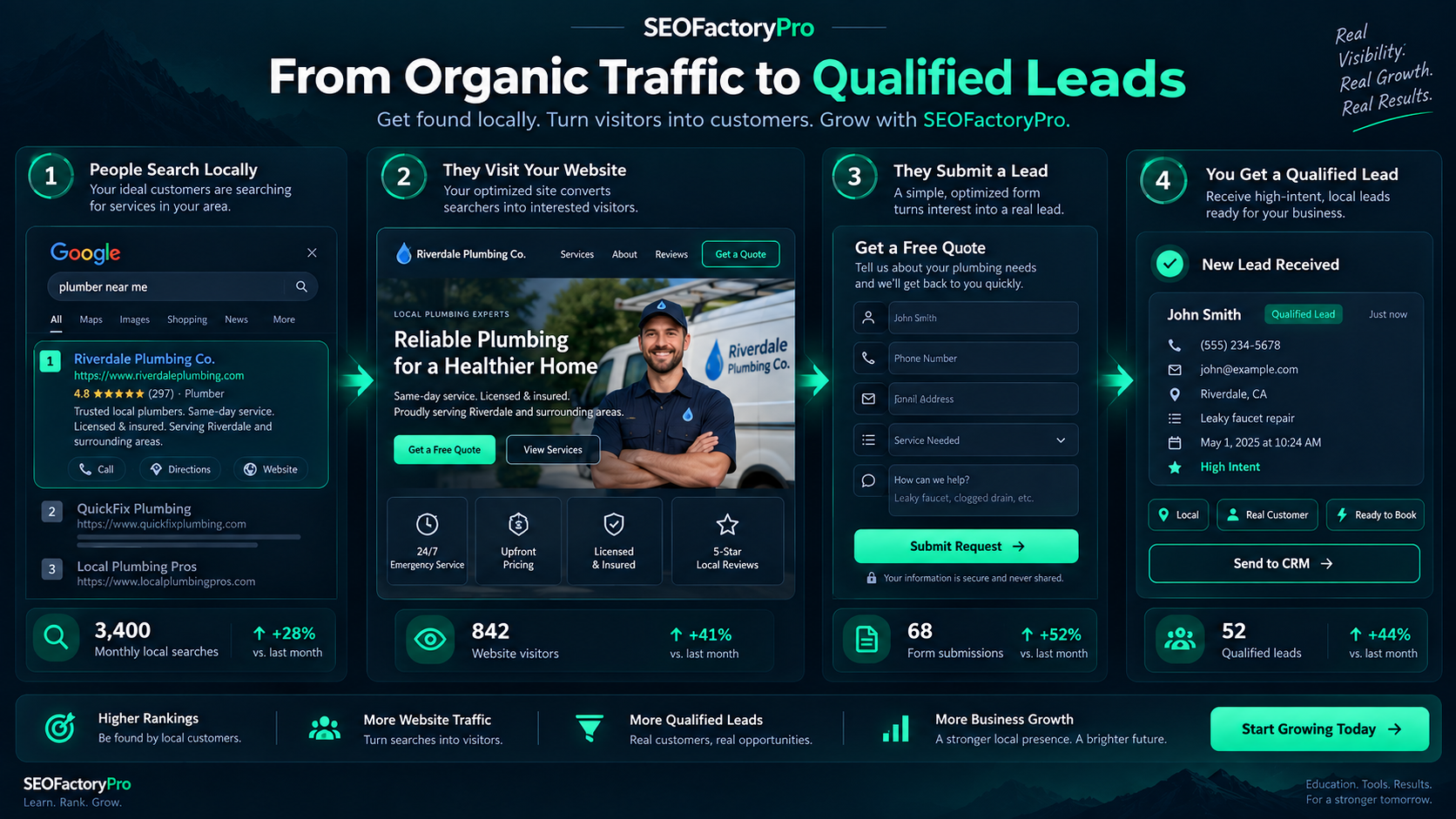
SEOFactoryPro teaches one loop repeated deliberately: understand demand, build something useful, make it crawlable, earn traffic, convert it honestly, then review what the data actually says before spending more time or money.
Six stages
The sequence in detail
Niche research
Study search demand, intent, SERP competition and the commercial value of an enquiry before writing a single page.
Website building
Plan a small, useful site structure: a clear service or topic hierarchy, honest copy and pages people can act on.
Indexing
Make sure pages render as HTML, return the right status codes, are canonical, linked internally and submitted for crawling.
Organic traffic
Improve coverage of the questions your audience actually searches, then expand only where queries prove real interest.
Lead generation
Turn visits into enquiries with accessible forms, transparent disclosure and a qualification process you can defend.
Analytics and scaling
Review Search Console data across the portfolio, separate observation from assumption, and reinvest where evidence supports it.
Why the order matters
Almost every avoidable failure in this field happens because a stage was skipped. Pages get written before anyone checked whether the query has commercial intent. Sites get expanded before a single page proved it could earn an impression. Enquiry forms get added without a plan for who answers them or what an enquiry is worth.
Working in order is slower at the start and much cheaper overall. A five-page site that targets a validated set of queries teaches you more in six weeks than a hundred pages built on a guess.
Evidence before expansion
Expansion decisions are made against measured data from your own Search Console properties: which queries produce impressions, which pages get impressions without clicks, which clusters attract nothing at all. Interpretation stays explicitly separate from observation — you record what the data shows, then record your hypothesis about why, and treat the second as a question rather than a conclusion.
Where AI helps and where it does not
AI is genuinely useful for drafting structures, proposing questions to investigate, and turning a messy spreadsheet into a shortlist of things worth checking. It is not a substitute for editorial judgement, factual verification or your responsibility for what you publish. Every AI-assisted workflow in the method has a human review gate before anything goes live.
Honest monetization
Lead generation is the primary model taught because it is the clearest link between search intent and revenue: someone needs a service, finds a useful page, makes an enquiry. Affiliate placements, directories, premium listings, subscriptions, advertising and commission arrangements are covered as alternatives, each with the disclosure and quality obligations they carry.
What this method does not promise
No ranking guarantee, no traffic guarantee, no income figure. Search results change, niches get more competitive and some projects simply do not work. The method is designed so that a project that fails does so cheaply and teaches you something specific.
Planned course